Metallurgy and Materials PE Exam Solved Problems eTextbook - 1 Year
Available in Print or eTextbook
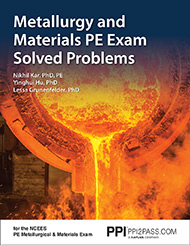
Metallurgy and Materials PE Exam Solved Problems (MLSP) offers comprehensive practice for the NCEES Metallurgy and Materials PE exam. This book is designed to help you pass the Metallurgy and Materials PE exam the first time.
Metallurgy and Materials PE Exam Solved Problems (MLSP) features include:
- 160 exam-relevant problems, grouped by four exam topics (Structure, Properties, Processing and Performance)
- Contains exactly twice the number of problems on each topic as does the exam
- Each chapter will be split into two sections, one for problems, the other for solutions
- Each problem section begins with short introductory paragraph
- All problems will be multiple choice
Exam Topics Covered
- Structure
- Crystal structure of metals, ceramics, polymers
- Diffusion
- Fractography
- Metallography
- Phase diagrams
- Properties
- Chemical analysis techniques
- Metallic and nonmetallic coatings
- Thermal stability, creep, stress rupture
- Low temperature and cryogenic behavior
- Composite materials
- Mechanical testing
- Processing
- Elastic/plastic deformation
- Casting
- Coating applications
- Cold work and annealing
- Heat transfer
- Heat treatments
- Brazing, soldering, welding
- Phase transformations, strengthening mechanisms for metals
- Powder processing
- Ceramic toughening
- Polymer toughening
- Performance
- Corrosion mechanics
- Compatibility
- Corrosion/aging tests
- Environmentally assisted cracking
- Failure analysis
- Fatigue analysis
- Life prediction
- Oxidation, creep
- Fracture mechanics
- Non-destructive testing
- Statistics
- States of Stress
- Wear mechanisms
FAQs
Some states require a BS degree from an ABET-accredited engineering program to sit for the PE exam. Other states allow you to take the PE exam with a degree in engineering technology, physics, math, or chemistry—or without any degree—as long as you’ve met the required work experience. Check your state requirements to see if you can take the PE exam without an engineering degree.
Most states allow you to take the PE exam after passing your FE exam and gaining at least four years of post-college work experience. However, some states now allow examinees to sit for the PE exam before completing their work experience. Check your state requirements to see when you’re qualified to sit for the exam.
By NCEES pass rates (January 2026), the highest first-time pass rates were PE Agricultural & Biological (81%), Mining & Mineral Processing (80%), Fire Protection (78%), and Mechanical: Thermal & Fluid Systems (77%). But the truly 'easiest' PE exam is the one whose content matches your daily work: alignment with your experience beats raw pass-rate statistics. Choose the discipline that supports your career goals.