Complete Print Bundle: PE Electrical Power
Content maps for the October 2025 exam and beyond now included as PDF downloads.
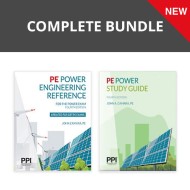
PE Power Reference Manual, 4th Edition by John Camara, PE has undergone an intensive transformation to ensure focused study for success on the new NCEES PE Electrical Power computer-based test (CBT). The new PE Power Study Guide correlates exam specifications to the NCEES Handbook and PPI’s PE Power Reference Manual.
The PE Electrical: Power exam is now offered year-round at approved Pearson Vue testing centers. The only resources examinees can use during the test will be the NCEES PE Electrical Power Reference Handbook and code books provided by NCEES. To succeed on exam day, you need to know how to solve problems using those resources. PE Power Reference Manual and Study Guide make that connection for you by highlighting NCEES equations in blue font and additional essential equations needed for the exam in red font to focus your exam prep.
New Features for the CBT Exam Include:
- Improved design to focus study on the most important exam material
- Explanations and demonstration of how to use NCEES handbook equations
- NCEES handbook equations are highlighted in blue for quick access
- Additional need-to-know exam equations marked in red for easy identification
- In chapter callouts map to specific handbook locations to streamline your review process
- PE Power Reference Manual, 4th Edition
- PE Power Study Guide, 4th Edition
- PE Power Practice Exams, 4th Edition
- PE Power Practice Problems, 4th Edition
- 2017 National Electrical Code NEC Quick-Card
- Casio FX-115 ES Plus Scientific Calculator
FAQs
Some states require a BS degree from an ABET-accredited engineering program to sit for the PE exam. Other states allow you to take the PE exam with a degree in engineering technology, physics, math, or chemistry—or without any degree—as long as you’ve met the required work experience. Check your state requirements to see if you can take the PE exam without an engineering degree.
Most states allow you to take the PE exam after passing your FE exam and gaining at least four years of post-college work experience. However, some states now allow examinees to sit for the PE exam before completing their work experience. Check your state requirements to see when you’re qualified to sit for the exam.
By NCEES pass rates (January 2026), the highest first-time pass rates were PE Agricultural & Biological (81%), Mining & Mineral Processing (80%), Fire Protection (78%), and Mechanical: Thermal & Fluid Systems (77%). But the truly 'easiest' PE exam is the one whose content matches your daily work: alignment with your experience beats raw pass-rate statistics. Choose the discipline that supports your career goals.