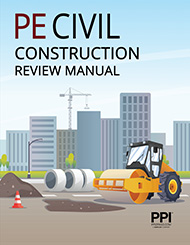
PE Civil Construction Review Manual
Available in Print or eTextbook
Fully updated to the new 2024 exam specifications! The PE Civil Construction Review Manual provides up-to-date and thorough review for the PE Civil Construction exam. This book takes you step by step through every exam topic and subtopic for thorough and focused coverage. References to the closed-book design standards and the NCEES Handbook prepare you to search quickly and efficiently during the exam for the information you need. Exam tips and examples throughout help you study efficiently for the exam.
Topics covered:
- Soil Mechanics
- Site Layout and Development
- Material Properties
- Estimating Quantities and Costs
- Project Planning and Scheduling
- Material, Production, and Execution Quality Control
- Structural Mechanics
- Hydraulics and Hydrology
- Construction Operations and Methods
- Design for Support of Construction Loads
- Heath and Safety
Design Standards Referenced:
- Guide to Formwork for Concrete (ACI 347R)
- Formwork for Concrete, 8th ed. (ACI SP-4)
- Steel Construction Manual (AISC)
- Design Loads on Structures During Construction (ASCE 37)
- Standard Practice for Bracing Masonry Walls Under Construction (CMWB)
- Manual on Uniform Traffic Control Devices for Streets and Highways—Part 6 Temporary Traffic Control (MUTCD-Pt6)
eTextbook Benefits:
- One year of access
- Ability to download the entire eTextbook to multiple devices, so you can study even without internet access
- An auto sync feature across all your devices for a seamless experience on or offline
- Unique study tools such as highlighting in six different colors to tailor your study experience
- Features like read aloud for complete hands-free review
FAQs
Some states require a BS degree from an ABET-accredited engineering program to sit for the PE exam. Other states allow you to take the PE exam with a degree in engineering technology, physics, math, or chemistry—or without any degree—as long as you’ve met the required work experience. Check your state requirements to see if you can take the PE exam without an engineering degree.
Most states allow you to take the PE exam after passing your FE exam and gaining at least four years of post-college work experience. However, some states now allow examinees to sit for the PE exam before completing their work experience. Check your state requirements to see when you’re qualified to sit for the exam.
By NCEES pass rates (January 2026), the highest first-time pass rates were PE Agricultural & Biological (81%), Mining & Mineral Processing (80%), Fire Protection (78%), and Mechanical: Thermal & Fluid Systems (77%). But the truly 'easiest' PE exam is the one whose content matches your daily work: alignment with your experience beats raw pass-rate statistics. Choose the discipline that supports your career goals.